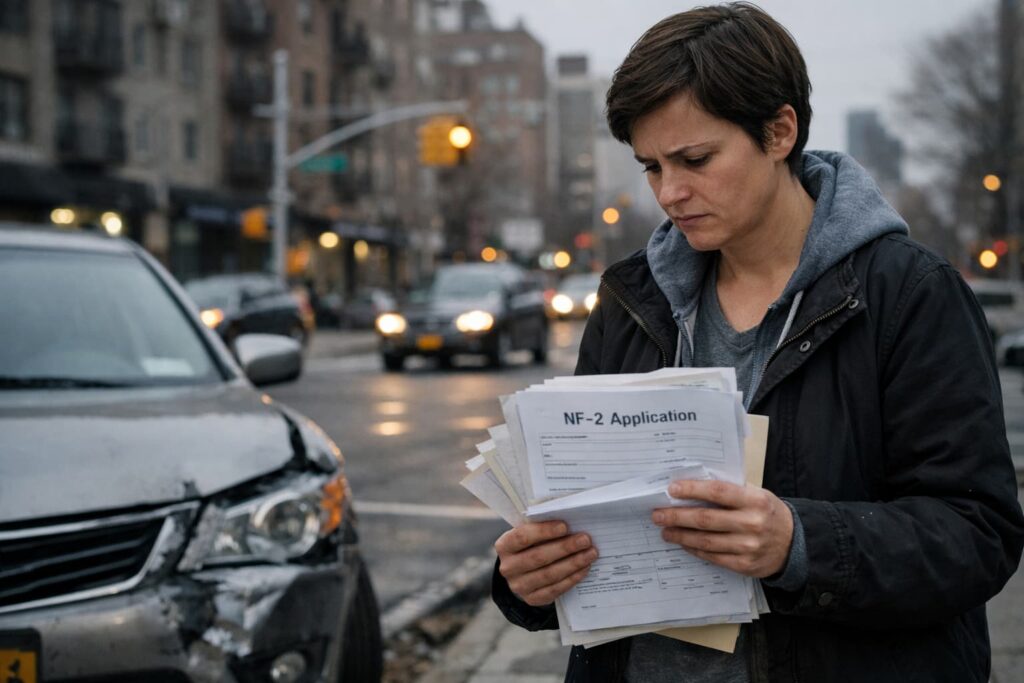
After a car accident in New York, many people assume the biggest issue will be proving who was at fault. For thousands of injured drivers and passengers, however, the first real obstacle is not liability—it is paperwork. Specifically, a little-known but critical form: the NF-2 no-fault application.
In New York, your own auto insurance is responsible for paying initial medical bills and a portion of lost wages, regardless of who caused the accident. But those benefits are not automatic. If you do not file the NF-2 Form within 30 days of the accident, you may lose access to those payments even if the injury was serious and clearly related to the crash.
Below, we explain what the NF-2 is, why this 30-day deadline matters so much, what happens if it is missed, and what options may exist when medical bills are already piling up.
Key Takeaways About the NF-2 No-Fault Application in New York
- In New York, your own insurance pays certain medical expenses and lost wages after an accident under the no-fault system.
- To receive those benefits, you must file Form NF-2 within 30 days of the accident.
- Missing this deadline can result in a complete denial of benefits, even for emergency care.
- Without no-fault coverage, medical bills can quickly become a serious financial burden.
- Limited exceptions may exist, but they are not guaranteed and depend on specific circumstances.
What Is the No-Fault System in New York?
New York uses an insurance system known as no-fault, also called Personal Injury Protection (PIP). This system was designed to ensure that injured people receive prompt medical care without waiting for fault to be determined.
Under this system, your own auto insurance may pay for:
- Reasonable and necessary medical treatment
- A portion of lost wages if you are unable to work
- Transportation expenses related to medical care
No-fault benefits may apply to drivers, passengers, and, in many cases, pedestrians struck by a properly insured vehicle.
What Is the NF-2 Form and Why Is It So Important?
The NF-2 Form is the official application used to activate no-fault benefits in New York. It is not a minor formality. It is the document that tells your insurance carrier:
“I was involved in an accident, and I am requesting no-fault coverage for my injuries.”
Without this form, the insurer is not required to pay medical bills or lost wages, even if the policy is active and the accident is well-documented.
The 30-Day Deadline: Why the Law Is So Strict
New York law requires that the NF-2 Form be submitted within 30 days of the accident. This deadline runs from the date of the crash, not from the first medical appointment, and not from when symptoms appear.
| Step | What to Do | When to Do It | Why It Matters |
| 1 | Confirm which insurance policy applies (driver / passenger / pedestrian) | As soon as possible | Sending the NF-2 to the wrong insurance company can waste valuable time and jeopardize coverage. |
| 2 | Request and complete the NF-2 Form | Within the first few days | This is the document that formally activates New York no-fault benefits. |
| 3 | Submit the NF-2 and keep proof of submission (confirmation / receipt / tracking) | Before day 30 | If a dispute arises, proof of timely submission may be critical to avoid a denial of benefits. |
| 4 | Begin or continue medical treatment and document symptoms | From the start and on an ongoing basis | Insurers may challenge whether the injury is related to the accident without consistent medical documentation. |
| 5 | Keep medical bills, prescriptions, transportation records, and treatment notes | Throughout the entire process | These records help support claims for “reasonable and necessary” medical care under no-fault. |
| 6 | If the deadline was missed, gather evidence explaining the delay (hospitalization / incapacity) | As soon as the delay is identified | Late-filing “exceptions” depend on documented justification and are not automatically granted. |
The purpose of this rule is to allow insurers to investigate claims promptly. In practice, however, the deadline often catches people off guard, especially those who:
- Are hospitalized or in rehabilitation
- Do not understand the no-fault system
- Assume the hospital or insurer will handle the paperwork
- Do not feel immediate pain
What Happens If You Miss the NF-2 Deadline?
Missing the 30-day deadline can have serious consequences. Most commonly, it leads to a denial of your no-fault benefits, which may mean:
- The hospital will bill you directly for emergency care
- Doctors may refuse to continue treatment
- Physical therapy could be discontinued
- You must rely on health insurance or pay out of pocket
- Medical debt accumulates quickly
For many families, this becomes an unexpected financial crisis when they thought they had insurance coverage to make these payments.
Who Pays Medical Bills If No-Fault Is Denied?
When no-fault coverage is denied, the immediate question is often: “So who pays my medical bills now?”
Possible options may include:
- Private health insurance (if available)
- Medicare or Medicaid
- Out-of-pocket payments
- Deferred billing arrangements with medical providers
However, none of these fully replace no-fault benefits, and some may raise subrogation issues later on.
Lost Wages and the Impact of the NF-2
No-fault benefits are not limited to medical care. They may also cover a portion of your lost wages if the crash injuries prevent you from working.
If the NF-2 is not filed on time:
- The no-fault carrier may deny wage-loss payments
- Employers are not required to compensate for missed work
- Financial pressure can increase rapidly without any income coming in
For households that rely on a steady income, this loss can be devastating.
Common Mistakes That Cause People to Miss the Filing Deadline
Many people miss the deadline due to confusion, not carelessness. Common filing mistakes include:
- Believing the hospital automatically submits the NF-2
- Assuming the police report is enough
- Waiting to see how the injury develops
- Not knowing which insurance company applies
- Assuming the deadline is longer than 30 days
These errors are especially common among people who have never been involved in a serious accident before. After being injured in any motor vehicle collision, it’s wise to talk to a personal injury lawyer to understand your rights and obligations and avoid missing out on any benefits.
Are There Any Exceptions to the 30-Day Deadline?
In limited situations, New York law allows late filing of the NF-2 if there is a valid justification, such as:
- Severe medical incapacity
- Prolonged hospitalization
- Reasonable lack of knowledge of the requirement
However, these exceptions are not automatic. The insurer will evaluate whether the delay is adequately explained and supported by documentation, and many late claims are denied.
How Insurance Companies Review Late Applications
When an NF-2 is submitted late, insurers may:
- Demand detailed explanations
- Require additional medical records
- Issue a formal denial of benefits
- Challenge the connection between the accident and the injury
Once benefits are denied, reversing that decision can be difficult and time-consuming.
The NF-2 Form vs. Other Insurance Notifications
It is important not to confuse the NF-2 with other documents, such as:
- Accident reports filed with the police
- Property damage claims
- Health insurance paperwork
The NF-2 is specific to no-fault PIP benefits and must be submitted separately.
Why Acting Quickly Matters—Even If You “Feel Fine”
After a car accident, many people believe everything is fine because they feel no immediate pain or were able to go home without hospitalization. However, feeling fine in the first few days does not always reflect what is happening inside the body.
Common auto accident injuries—such as concussions, neck and back injuries, nerve damage, or internal injuries—may take days or even weeks to fully appear. Adrenaline, stress, and delayed inflammation can initially mask serious symptoms after a crash.
Waiting for pain to develop before taking action to initiate insurance coverage can have serious consequences. If symptoms develop after the 30-day deadline has passed, the insurer may argue that you lost your right to no-fault benefits, even when the injury is clearly related to the accident.
Filing the NF-2 form on time does not mean you are exaggerating your condition or committing to specific treatment. It means you are protecting your insurance rights in case your condition changes, worsens, or requires medical care later.
In many cases, taking this step early is what makes the difference between receiving covered treatment and facing unexpected medical bills once symptoms finally appear.
Frequently Asked Questions About the NF-2 No-Fault Form and the 30-Day Deadline
What happens if I file the NF-2 on day 31?
Submitting the NF-2 even one day late may result in a full denial of no-fault benefits. While some insurers review late explanations, they are not required to accept them.
In such situations, it is essential to determine whether a valid justification—such as medical incapacity—exists and to document it accurately. Speaking with an experienced car accident lawyer can help determine whether any options remain.
Should I file the NF-2 if I did not go to the hospital right away?
Yes. Many people delay medical treatment because symptoms appear later or seem manageable at first. Filing the NF-2 within the deadline protects your right to no-fault benefits even if treatment begins later. Waiting until you feel “seriously injured” can jeopardize coverage. A lawyer can help you document injuries that develop over time.
Does the NF-2 cover all medical bills related to the accident?
No-fault insurance may cover reasonable and necessary medical treatment within policy limits, but it does not guarantee payment for every form of care. Insurers often review medical necessity, duration of treatment, and the relationship to the accident. When disputes arise, understanding what should be covered and how to respond can be critical.
What if I do not know which insurer is responsible?
This is more common than many people realize, especially in multi-vehicle accidents or when the injured person was a passenger or pedestrian. Identifying the correct insurer is critical because submitting the NF-2 to the wrong company does not stop the 30-day clock. A New York injury lawyer can help identify the proper coverage quickly and avoid costly mistakes.
Does the NF-2 apply if I was a passenger or pedestrian?
In many cases, yes. The no-fault system may apply even if you were not driving. However, determining which policy applies can be more complex in these situations. Passengers and pedestrians often have multiple potential sources of coverage, and selecting the correct one can significantly impact whether benefits are approved or denied.
Speak With Our Dedicated Personal Injury Lawyers at Omrani & Taub, P.C. Before You Miss Any Deadlines
The 30-day deadline to file the NF-2 Form is one of the strictest and least understood rules in New York car accident cases. Missing it can mean paying emergency medical bills out of your own pocket, even when insurance coverage is in place.
If you or a loved one was injured in an accident and you are unsure whether this requirement was met, speaking with a lawyer may help you understand what options may remain. The Law Offices of Omrani & Taub, P.C. offers free consultations and bilingual services to help injured individuals navigate the no-fault system and protect their rights.
Call 1-800-JUSTICE® to get clear answers, understand your rights, and take the next step to a better future.