Motorcycle riders in New York City know the reality of traffic all too well. Congested avenues, sudden lane changes, delivery vehicles double-parked without warning, and impatient drivers make navigating the city on two wheels uniquely challenging. In that environment, some riders choose to lane split or lane filter to move through stopped or slow-moving traffic.
But what happens when a crash occurs while you’re doing it? Many injured riders immediately fear the worst and wonder… “Lane splitting is illegal in New York—does that mean I automatically lose my injury case?”
Insurance companies are quick to reinforce that fear. They often argue that because lane splitting violates New York traffic law, the motorcyclist must be fully at fault. That assumption is wrong.
While lane splitting and lane filtering are not legal in New York, they are not an automatic bar to recovery. New York’s comparative negligence law allows injured riders to pursue compensation even if they were partially at fault—sometimes significantly so. In many lane-splitting crashes, the driver of the car still bears meaningful responsibility.
Understanding how fault is actually analyzed in these cases can make the difference between a denied claim and a successful recovery. We’ll dig into the general rules below, but for accurate legal advice about your unique situation, reach out to an experienced New York motorcycle accident lawyer to learn more.
Key Takeaways About Lane Splitting Accidents in New York
- Lane splitting and lane filtering are illegal under New York law, but illegality alone does not automatically eliminate a rider’s right to compensation.
- New York follows a pure comparative negligence system, which allows recovery even when a rider shares fault.
- Drivers who change lanes unsafely, fail to signal, or do not check blind spots may still be partially liable.
- Insurance companies often exaggerate a rider’s fault to minimize payouts.
- A skilled New York motorcycle accident lawyer can fight to reduce comparative fault and protect the value of the claim.
What Is Lane Splitting and Lane Filtering?
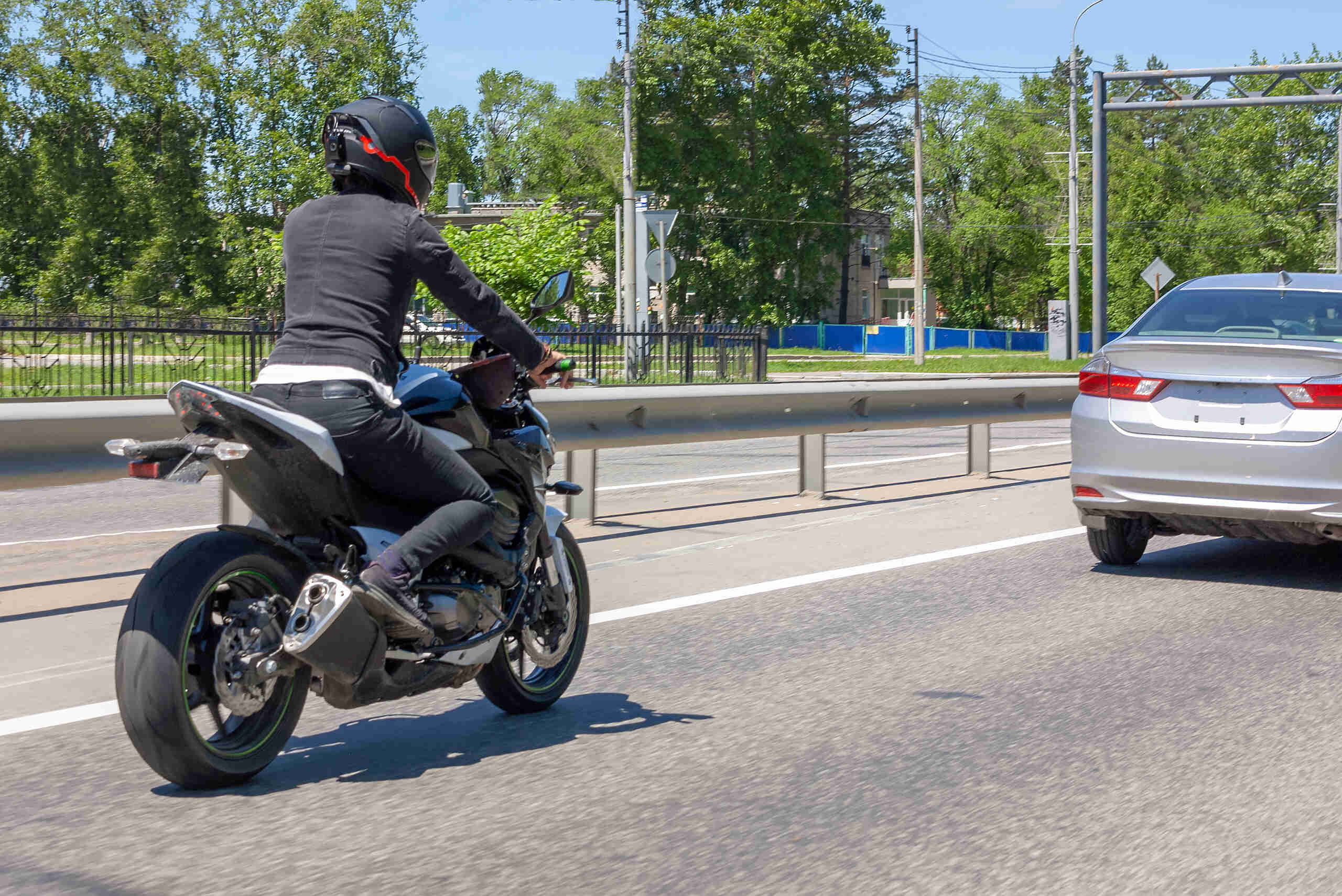
Lane splitting generally refers to riding a motorcycle between lanes of moving traffic, often at highway speeds. Lane filtering is typically used to describe riding between stopped or slow-moving vehicles, such as at traffic lights or in gridlocked conditions.
While the terms are sometimes used interchangeably, both practices involve a motorcycle occupying the space between lanes rather than remaining fully within a single lane. In some states, such as California, lane splitting is explicitly permitted under certain conditions. In New York, it is not.
Is Lane Splitting Legal in New York?
No. Under New York Vehicle and Traffic Law §1122, motorcycles are prohibited from overtaking or passing vehicles within the same lane or between lanes of traffic. This statute forms the basis for claims that lane splitting and lane filtering are illegal in New York.
Because of this prohibition, riders who are filtering or splitting at the time of a crash are often issued traffic citations or blamed by insurers from the outset. However, a traffic violation is not the same thing as civil liability. This distinction is critical.
An Illegal Traffic Act Does Not Automatically Mean You Are at Fault
One of the most common misconceptions in motorcycle injury cases is the belief that violating a traffic law automatically makes the rider 100% responsible for the crash. That is not how New York personal injury law works.
New York applies a pure comparative negligence system. This means that fault is apportioned between all parties involved in an accident based on their respective conduct. Even if a rider violated the law, the driver’s actions must still be examined.
For example, a rider who was lane filtering may bear some responsibility—but that does not excuse a driver who:
- Changed lanes without signaling
- Failed to check mirrors or blind spots
- Drifted out of their lane
- Opened a car door without looking
- Made an unsafe turn across traffic
In these scenarios, fault is shared. The key legal question becomes how much fault each party bears, not whether the rider can recover at all.
Comparative Negligence: How Fault Affects Compensation in Lane Splitting Cases
New York’s pure comparative negligence system plays a central role in motorcycle accident cases involving lane splitting or filtering. Under this rule, fault is not treated as an all-or-nothing issue. Instead, responsibility for the crash is divided among everyone whose conduct contributed to the accident.
This means that even if a motorcyclist is found to have violated a traffic law—such as New York’s prohibition on lane splitting—that violation does not automatically eliminate their right to recover compensation. Instead, the court or insurance company must still evaluate how much each party’s actions contributed to what happened.
If a rider is assigned a percentage of fault, their total compensation is reduced by that percentage—but it is not completely barred. For example, if a rider is found to be 30% responsible for a crash, they may still recover 70% of their losses. Even if the rider’s fault is assessed at 80%, the rider may still recover the remaining 20% of their damages.
This framework is especially important in lane-splitting cases because insurance companies often try to portray the rider’s conduct as the sole cause of the crash. In reality, many of these accidents involve multiple contributing factors. The driver’s actions can carry significant legal weight, even if the rider was filtering between lanes at the time.
The practical impact of comparative negligence cannot be overstated. A difference of just 10% or 20% in fault allocation can mean tens or even hundreds of thousands of dollars in compensation. This is why insurers fight so aggressively to inflate a rider’s share of blame—and why careful legal advocacy is essential.
A skilled New York motorcycle accident lawyer can focus on minimizing your percentage of fault by grounding the case in objective evidence rather than assumptions or stereotypes about motorcyclists. By clearly demonstrating how the driver’s conduct contributed to the collision, it is often possible to significantly reduce comparative fault and preserve the full value of the claim.
In lane-splitting cases, the question is not simply whether the rider broke a traffic rule. The real legal question is how the crash happened, who acted unreasonably, and how responsibility should be fairly divided under New York law.
Common Lane Splitting Accident Scenarios in NYC
Lane splitting accidents tend to follow predictable patterns, especially in dense urban traffic.
Sideswipe collisions are among the most common. These occur when a driver drifts or moves into an adjacent lane without noticing a motorcycle traveling between lanes. Because motorcycles are narrower and less visible, drivers often claim they “never saw” the rider.
Another frequent scenario involves sudden lane changes in stop-and-go traffic. A driver, frustrated by congestion, may quickly switch lanes without signaling, striking a motorcycle filtering forward.
Dooring incidents also occur when a driver or passenger opens a door into traffic without checking, striking a rider moving between lanes of stopped vehicles.
Each of these scenarios requires careful reconstruction to determine who acted unreasonably under the circumstances. A dedicated personal injury lawyer who focuses on motorcycle accidents in New York will understand how to gather the evidence needed to explain what happened and who is at fault in a NY motorcycle crash. Choosing the best lawyer for your claim is one of the most important decisions you can make at this point. This legal support is vital to ensure you access all available recovery sources, such as SUM coverage in New York, which acts as a critical safety net when the at-fault driver’s insurance is insufficient to cover your total losses.
How Insurance Companies Use Lane Splitting as a Defense Strategy
Insurance companies routinely seize on lane splitting as a way to inflate a rider’s comparative fault percentage. Their goal is simple: to reduce what they have to pay, not compensate you for your losses.
Common insurer arguments include claims that the rider:
- “Assumed the risk” by lane splitting
- Was traveling too fast for the conditions at the time of the accident
- Should have anticipated unsafe driver behavior
- Created an unavoidable situation
These arguments are often exaggerated and unsupported by evidence. They rely on bias against motorcyclists rather than a balanced analysis of the crash. This bias is especially damaging because New York law already excludes motorcyclists from the No-Fault system, leaving riders without the automatic medical coverage that other drivers receive.
An experienced New York motorcycle accident lawyer will anticipate these arguments and challenge them with accident reconstruction, traffic data, and witness testimony to build a strong case on your behalf.
What Evidence Matters in Lane Splitting Accident Cases?
Because fault will likely be so heavily contested, solid evidence plays a central role in these cases. Useful evidence may include:
- Traffic camera footage
- Surveillance video from nearby buildings
- Dashcam footage
- Vehicle damage patterns
- Witness statements
- Police accident reports
- Cell phone data indicating distraction
- Expert accident reconstruction analysis
Quick legal action helps preserve this evidence before it is lost or overwritten. This is why it’s crucial to partner with an aggressive motorcycle accident law firm as quickly as possible after a crash.
Does Lane Splitting Affect Injury Severity and Damages?
Lane splitting cases often involve severe injuries because the rider may be struck laterally or thrown from the motorcycle. These crashes can result in traumatic brain injuries, spinal damage, fractures, road rash, and internal injuries.
The severity of injuries often underscores why insurers fight so aggressively to limit liability. Serious damages increase their financial exposure, making comparative fault arguments even more important to their defense strategy.
Frequently Asked Questions About Lane Splitting Accidents in New York
Can a police report stating I was lane splitting end my case?
Not necessarily. While a police report may note that a rider was filtering between lanes, it is not the final word on liability. Police reports are often based on limited information gathered at the scene and may not fully capture driver behavior, visibility issues, or unsafe lane changes. A thorough legal investigation can uncover evidence—such as vehicle damage patterns, surveillance footage, or witness statements—that tells a more complete story.
Can I still sue if I received a ticket for lane splitting?
Yes. A traffic ticket does not automatically determine civil liability. You may still pursue a personal injury claim. An experienced NY motorcycle crash attorney can review your situation and explain your unique rights under the circumstances during a free consultation.
Can comparative negligence affect settlement negotiations as well as trials?
Yes. Comparative negligence plays a major role long before a case ever reaches court. Insurance companies use fault percentages to justify lower settlement offers. When a lawyer can reduce a rider’s assigned fault early in the process, they can significantly improve negotiation leverage and increase the likelihood of a fair resolution.
Why is legal representation especially important in lane-splitting accidents?
Lane splitting cases are more complex than standard motorcycle accidents because they involve both statutory violations and nuanced fault analysis. An experienced motorcycle accident lawyer can identify evidence that counters unfair assumptions, challenge inflated fault claims, and ensure that liability is evaluated based on what actually happened—not on stereotypes about motorcyclists.
Do juries automatically blame motorcyclists?
Not necessarily. When cases are properly presented with evidence and professional analysis, juries often recognize shared responsibility with the at-fault driver.
How a New York Lane Splitting Accident Lawyer Can Help
Lane-splitting cases require careful investigation and handling because insurers are aggressive and fault is contested from the outset. A knowledgeable motorcycle accident lawyer can:
- Investigate the crash thoroughly
- Preserve critical evidence
- Challenge exaggerated fault claims
- Work with reconstruction experts
- Negotiate assertively with insurers
- Present a clear, fact-driven liability narrative
These cases are not about excusing illegal behavior—they are about fairly assigning responsibility under New York law and fighting for the compensation you need to cover your losses.
Speak With a New York Motorcycle Accident Lawyer at Omrani & Taub to Learn More
Lane-splitting accidents are legally complex, but they are not unwinnable. New York law allows injured riders to pursue compensation even when mistakes were made—so long as responsibility is evaluated fairly.
If you were injured while lane splitting or filtering in New York City, speaking with a motorcycle accident lawyer at The Law Offices of Omrani & Taub, P.C. can help you understand how comparative negligence applies to your case and what options may be available.
We offer free consultations and bilingual assistance to help injured riders get clear, honest guidance during a difficult time. Call 1-800-JUSTICE® to learn more and take the next step with confidence.